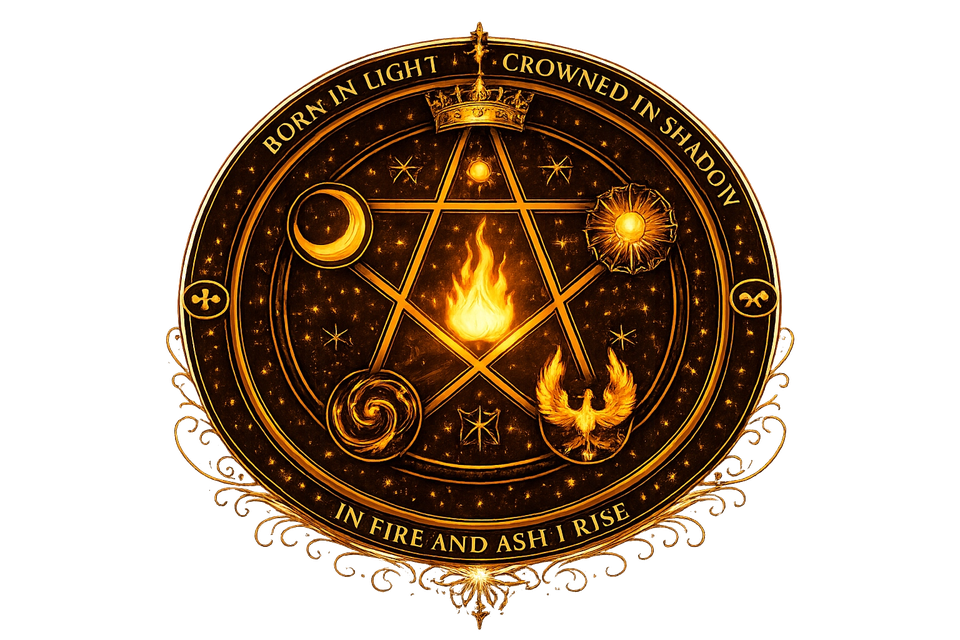
There have been moments in my life when everything I thought I was burned down.
Not metaphorically. Not in the gentle, instructive way that spiritual teachers sometimes describe growth — as a comfortable shedding of outgrown things. I mean the kind of burning that strips identity to the bone. When the roles that held you, the relationships that shaped you, the context that gave your life its coherence — when those are gone, what is left?
This is not a rhetorical question. It is the central question of the Phoenix path, and it has an answer. But you cannot receive the answer intellectually. You can only come to know it by surviving something that should not have been survivable — and discovering, on the other side, that you are still there.
What the Fire Does
Fire in alchemical tradition does not destroy indiscriminately. It consumes what cannot withstand it and reveals what can. The alchemist's fire separates the essential from the accidental — the lead from the gold that was hidden within it all along.
The fires of lived experience work the same way, though rarely gently. Loss burns. Betrayal burns. The collapse of a long-held identity burns. The long years of surviving things that should not have had to be survived — those burn slowly, in the body and the psyche, in ways that are sometimes not fully felt until much later.
"What the fire cannot consume is not what is hardest or most defended. It is what is most essentially you — before the adaptations, before the armor, before the identities built for survival."
The Thing That Remains
I have a different relationship to what this is for different people. For some it arrives as a quality of attention — a particular way of seeing that has persisted through every version of the self, recognizable in childhood and in crisis and in the ordinary morning light. For others it is something more like a direction — a pull toward something true that has survived every attempt to extinguish it. For others still it arrives as the capacity to feel, even when everything else has gone numb. The burning, itself, as proof of life.
What I know — what I have come to know, not from reading but from living — is that this thing is real. It is not a consolation story told to make the burning more bearable. It is the actual structure of the self at its deepest level: something that the fire cannot reach because it is the fire. The Eternal Flame of the Atlas is not metaphor. It is the naming of something people who have survived real loss already know.
Working With What Remains
Once you have found it — or once it has found you, in the way that it often does in the aftermath of great burning — the work becomes the tending. Not the protecting. Not the shielding or the hoarding. The tending, the way you tend a fire: with presence, with fuel, with the patience to sit with something alive and responsive and not try to own it.
This is what the magical path, at its most mature, becomes: the practice of returning again and again to the flame at the center of your own life, and learning to build from that — rather than from the accumulated debris of who you were told to be, or who you needed to be in order to survive, or who you became when the conditions of living required it.
There is something in you that the fire cannot consume. Not because it is untouchable — but because it is the fire itself.
Everything this work is built on — every book, every constellation, every framework in the Atlas — is built around that recognition. Around the belief that the most essential work of a human life is learning to find that flame, and to live from it, and to refuse — finally, completely — to let it be extinguished by anything or anyone again.
Ex Igne et Cinere Surgo. From fire and ash, I rise.